The rapidly converging elements include the Psalm 83 prophecy, the threat of a Middle East war, Israel, and the rapture. Could 2026 mark the removal of the Church before the Tribulation?
Introduction: Why Watch Psalm 83 Now?
Bible prophecy is not given to satisfy curiosity but to sharpen discernment and awaken urgency. In a world increasingly hostile to God, Israel stands once again at the centre of global tension—just as Scripture foretold. Psalm 83 describes a unified conspiracy by Israel’s surrounding enemies to erase her from existence, a scenario that looks disturbingly familiar in today’s Middle East.
With war clouds gathering over Israel, Iran and its proxies threatening annihilation, and the global order rapidly shifting, many believers are asking whether we are approaching a pivotal prophetic moment. Could the Psalm 83 prophecy be on the verge of fulfilment?
And if so, does this align with the nearness of the rapture of the Church—possibly as early as 2026?
This article examines Psalm 83 in light of current events, biblical prophecy, and a watchman’s timeline perspective, encouraging believers to remain alert, grounded in Scripture, and ready for the Lord’s return.
Watching Prophecy Unfold Before Our Eyes

Students of Bible prophecy have always understood that God reveals His plans progressively through Scripture and history. Jesus Himself told us to “watch” (Matthew 24:42), and the sons of Issachar were commended because they “understood the times and knew what Israel should do” (1 Chronicles 12:32).
As we approach 2026, events in the Middle East are accelerating at a breathtaking pace. Israel finds itself surrounded by increasingly hostile neighbours, while alliances are being formed that mirror ancient biblical descriptions with striking precision. For many believers, the current situation raises an unavoidable question:
Are we on the brink of the Psalm 83 war—and could this be directly connected to the imminent rapture of the Church?
This article explores that possibility, not with sensationalism, but with sober biblical reflection and an awareness of the times in which we live.
Understanding Psalm 83
Psalm 83 is a prayer of Asaph, calling on God not to remain silent in the face of a coordinated conspiracy against Israel:
“They have said, ‘Come, and let us cut them off from being a nation, that the name of Israel may be remembered no more.’” (Psalm 83:4)
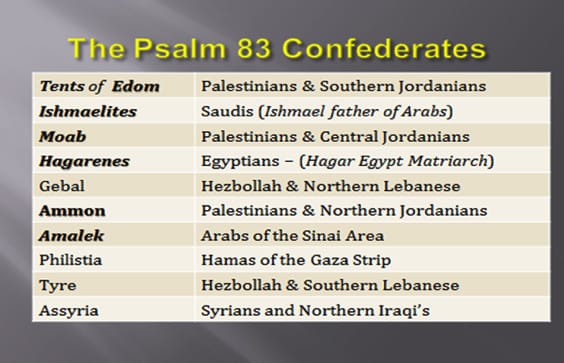
Unlike Ezekiel 38–39, Psalm 83 describes Israel’s immediate neighbours, not distant powers. The psalm lists nations and peoples that today correspond closely to:
- Lebanon (Hezbollah / Tyre)
- Gaza (Philistines)
- Jordan (Ammon, Moab)
- Southern Lebanon & Syria (Gebal)
- Arab populations surrounding Israel (Edom, Ishmaelites)
- Assyria, widely understood by many scholars as modern-day Syria and/or elements of Turkey
The objective is clear: the total eradication of Israel as a nation.
This is not merely hostility—it is genocidal intent.
A Coalition We See Forming Today
What makes Psalm 83 so compelling today is not just the list of enemies but the unity of purpose:
In our time, we see:
- Iran openly calling for Israel’s destruction
- Hezbollah positioned with massive missile arsenals in Lebanon
- Hamas and Islamic Jihad operating from Gaza
- The Houthis in Yemen declaring war on Israel
- Syria serving as a launchpad for Iranian proxies
“They are confederate against You; they have made a covenant against You.” (Psalm 83:5)
Though Iran itself is not named in Psalm 83, it functions today as the chief orchestrator behind many of these actors—financing, arming, and directing them.
The language of Psalm 83 feels less like ancient poetry and more like a modern intelligence briefing.
Is the Psalm 83 War Separate from Ezekiel 38–39?
Many prophecy students believe the Psalm 83 conflict is distinct from the Gog–Magog war of Ezekiel 38–39 for several reasons:
- Psalm 83 involves immediate neighbours, not distant nations like Russia or Persia acting independently.
- Israel appears vulnerable, not dwelling securely.
- The outcome seems to result in Israel expanding its territory and security, which may help set the stage for later prophetic events.
If this understanding is correct, Psalm 83 may serve as a precursor to war, reshaping the Middle East and dramatically altering Israel’s strategic position.
Why 2026? A Watchman’s Perspective
Scripture warns against reckless date-setting, yet it never discourages careful watching. Jesus rebuked those who could interpret the weather but failed to discern “the signs of the times” (Matthew 16:3). Biblical chronology, when handled humbly and reverently, can offer markers rather than mandates.
One compelling reason many prophecy students are watching 2026 is rooted in a broader redemptive timeline:
The 2000-Year Pattern
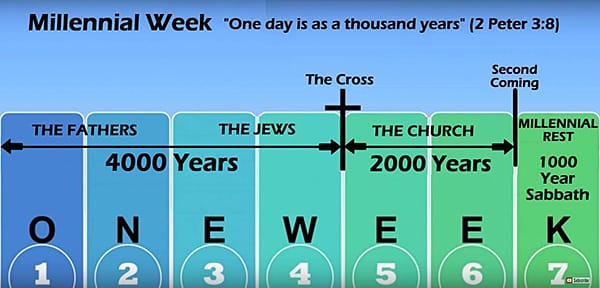
Many scholars and Bible teachers believe Jesus was crucified in 33 AD, a date supported by historical, astronomical, and biblical evidence. If this is correct, it opens a fascinating prophetic framework.
Scripture often points to a 6,000-year human history followed by a 1,000-year reign of Christ (the Millennial Kingdom), mirroring the six days of creation followed by the Sabbath rest (Genesis 1–2; Hebrews 4:9). Within this model:
- Jesus’ death and resurrection in 33 AD would mark the midpoint of God’s redemptive timeline
- 2033 would represent 2,000 years since the cross
- Christ’s return to earth to establish His Millennial Kingdom would align with that 2,000-year marker
If the Second Coming occurs in 2033, then the seven-year Tribulation described in Daniel 9 and Revelation must precede it.
That places the rapture of the Church—prior to the Tribulation—around 2026.
This does not constitute dogmatic date-setting, but it does provide a biblically consistent window of expectation, especially when combined with the accelerating convergence of prophetic signs we see today.
Scripture warns against careless date-setting, yet it also encourages discernment. Jesus rebuked those who could read the weather but not “the signs of the times” (Matthew 16:3).
Several factors make 2026 stand out to many watchful believers:
- The rapid convergence of Middle East hostilities
- The moral, spiritual, and cultural collapse of the West
- Increasing global calls for centralized governance and control
- The growing isolation of Israel on the world stage
- A heightened sense of urgency within the Body of Christ
For those who hold to a pre-tribulation rapture, the next major prophetic event is not war—but the sudden removal of the Church.
“For the Lord Himself will descend from heaven with a shout… and the dead in Christ will rise first. Then we who are alive and remain shall be caught up together with them in the clouds.” (1 Thessalonians 4:16–17)
If Psalm 83 is indeed imminent, it may unfold just before or shortly after the rapture, when restraint is removed and chaos accelerates.
The Bridegroom Is at the Door

The rapture is not about escape—it is about relationship. Christ is coming for His Bride, just as He promised (John 14:1–3).
The world is not moving toward peace and enlightenment; it is moving toward deception, conflict, and judgement. At the same time, God is mercifully giving warning after warning.
Psalm 83 reminds us that:
- God is not finished with Israel
- Nations will be held accountable for how they treat His chosen people
- Human conspiracies will ultimately fail against a divine purpose.
“That they may know that You, whose name alone is the LORD, are the Most High over all the earth.” (Psalm 83:18)
A Final Word of Urgency
Whether 2026 proves to be the year of the rapture or not, the nearness of these events should stir every believer to holy living, evangelism, and watchfulness.
If you are reading this and do not know Jesus Christ as Lord and Saviour, now is the time. The door of grace remains open—but it will not remain open forever.
The stage is set. The players are in position. The curtain is about to rise.
“Even so, come, Lord Jesus.” (Revelation 22:20)