
A Prophetic Warning for Our Time
There is a remarkable phrase in the Bible that deserves our attention at this particular moment in history: “Peace and safety.” The words appear in one of the New Testament’s most important passages concerning the coming Day of the Lord, and when they are compared with the warnings given centuries earlier by the prophets Jeremiah and Ezekiel, a striking pattern emerges. Again and again, God’s people were being reassured that everything was going to be all right when God Himself said that judgement was approaching.
Jeremiah described false prophets who were saying, “Peace, peace; when there is no peace” (Jeremiah 6:14, KJV). A few chapters later he repeated the warning: “For they have healed the hurt of the daughter of my people slightly, saying, Peace, peace; when there is no peace” (Jeremiah 8:11, KJV). Ezekiel confronted the same kind of false assurance, saying of the prophets of Israel, “Peace; and there was no peace” (Ezekiel 13:10, KJV), and later describing those who “see visions of peace for her, and there is no peace” (Ezekiel 13:16, KJV).
Then we come to Paul’s warning in 1 Thessalonians:
“For when they shall say, Peace and safety; then sudden destruction cometh upon them, as travail upon a woman with child; and they shall not escape.”
— 1 Thessalonians 5:3, KJV
The historical circumstances in Jeremiah and Ezekiel are not the same as those described by Paul, and we should not force them together as though they were all predicting one identical event. Jeremiah was warning Judah about impending judgement, Ezekiel was confronting false prophets concerning Jerusalem, and Paul was speaking about the future Day of the Lord. Yet the spiritual pattern connecting these passages is unmistakable: a proclamation of peace and security in the midst of a situation in which God’s judgement is approaching.
That should make us stop and think very carefully about the times in which we are living.
“Peace, Peace; When There Is No Peace”
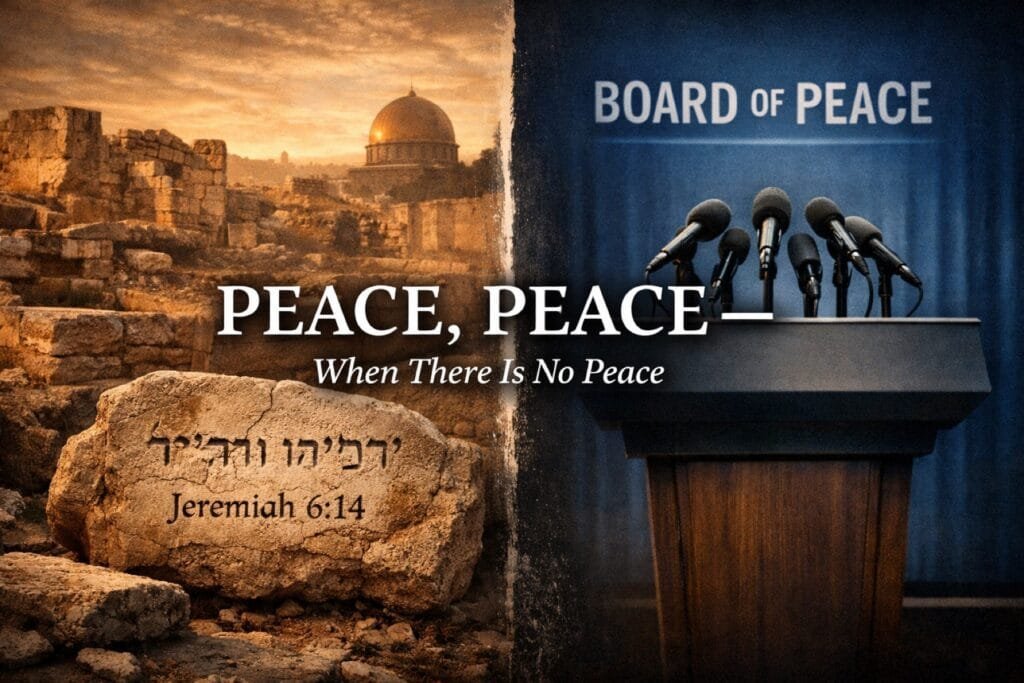
To understand the significance of Paul’s words, it is helpful to begin with Jeremiah. The prophet was living at a time when Judah’s spiritual condition had become desperately serious. The nation had turned away from God, sin was widespread, and divine judgement was approaching. Yet instead of faithfully warning the people, false prophets were giving them reassurance.
Jeremiah wrote, “They have healed also the hurt of the daughter of my people slightly, saying, Peace, peace; when there is no peace” (Jeremiah 6:14, KJV).
The picture is of a wound that has not really been healed. Something is seriously wrong beneath the surface, but rather than dealing with the problem, it is covered over. The patient is reassured, the wound is treated superficially, and everyone is encouraged to believe that the situation is under control.
But God says there was no peace.
That is what made the message so dangerous. The false prophets were not merely mistaken about some minor detail. They were giving people a false sense of security at the very time when they needed to hear God’s warning and turn back to Him.
Jeremiah repeated the same accusation in chapter 8: “For they have healed the hurt of the daughter of my people slightly, saying, Peace, peace; when there is no peace” (Jeremiah 8:11, KJV). The repetition tells us something about the seriousness of the deception. God wanted His people to understand that the soothing message being given to them was not harmless optimism. It was preventing them from facing reality.
The people were being told what they wanted to hear instead of what they needed to hear.
That is an important distinction.
There is nothing wrong with wanting peace. There is nothing wrong with praying for peace, working for peace, or hoping that nations will settle their differences. The problem comes when the promise of peace is used to conceal the truth, when people are told that everything is well even though God has warned that judgement is coming.
Ezekiel and the Wall of “Untempered Morter”
Ezekiel gives us an equally powerful picture. In chapter 13, God condemns the false prophets who were deceiving His people:
“Because, even because they have seduced my people, saying, Peace; and there was no peace; and one built up a wall, and, lo, others daubed it with untempered morter.”
— Ezekiel 13:10, KJV
The imagery is striking. A wall has been built, but something is wrong with it. Instead of properly repairing the weakness, the prophets cover it with “untempered morter.” The wall may look sound from the outside, but its apparent strength is deceptive.
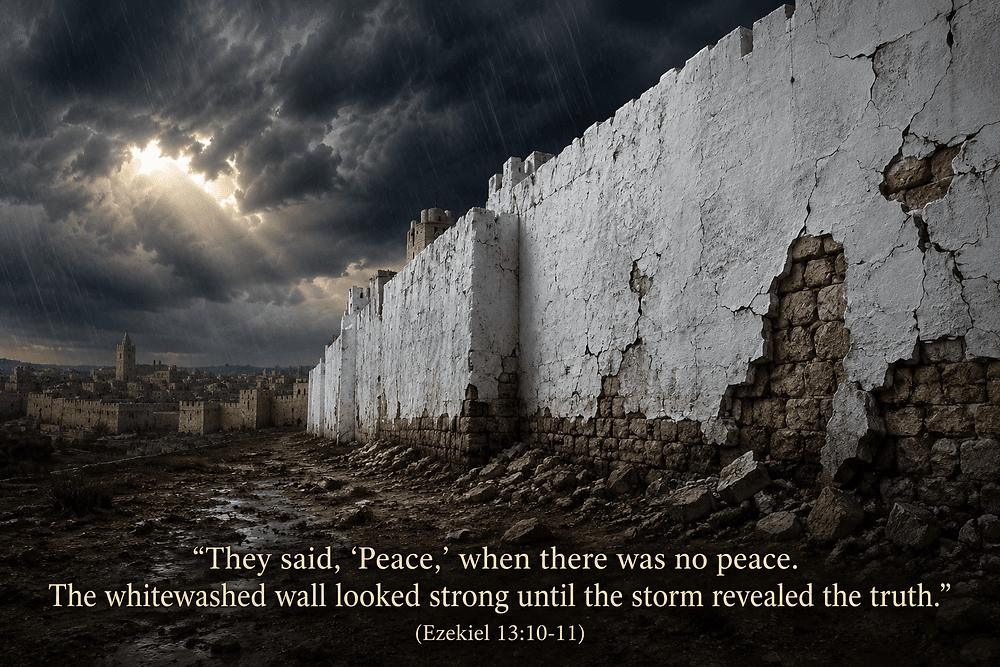
That is an excellent picture of false reassurance.
A false message does not necessarily remove the problem. It simply hides it.
A person can cover sin without repenting of it. A nation can cover moral corruption without turning back to God. A religious leader can cover spiritual sickness with comforting words. A government can promise security without being able to guarantee it. A society can proclaim peace while the foundations beneath it are becoming increasingly unstable.
God’s objection was not simply that these prophets were optimistic. It was that they were lying about the condition of the people.
Later in the chapter, God describes them again:
“To wit, the prophets of Israel which prophesy concerning Jerusalem, and which see visions of peace for her, and there is no peace, saith the Lord GOD.”
— Ezekiel 13:16, KJV
Jeremiah and Ezekiel were therefore confronting a common spiritual problem. The people had been given a message of peace when God said there was no peace.
And that is precisely why their words help us understand the significance of Paul’s warning to the Thessalonians.
“Peace and Safety” and the Coming Day of the Lord
Paul begins the fifth chapter of 1 Thessalonians by discussing “the times and the seasons” and the coming Day of the Lord. He writes, “For yourselves know perfectly that the day of the Lord so cometh as a thief in the night” (1 Thessalonians 5:2, KJV).
Then comes the remarkable statement in verse 3: “For when they shall say, Peace and safety; then sudden destruction cometh upon them, as travail upon a woman with child; and they shall not escape.”
Notice carefully what Paul says. He does not necessarily say that genuine, lasting peace will have been achieved. He says “when they shall say, Peace and safety.” The emphasis is on the declaration and the confidence that accompanies it.
People will be saying that things are secure.
People will believe that things are under control.
People will be looking toward peace and stability.
And then, unexpectedly, destruction comes.
This is where Jeremiah and Ezekiel provide such an important background. In their day, people were being reassured with the promise of peace while God’s judgement was approaching. Paul describes an end-times situation in which there will likewise be a proclamation of peace and safety immediately before sudden destruction.
The circumstances are different, but the principle is the same: human confidence does not cancel divine judgement.
A world can feel safe and still be in danger.
A nation can proclaim peace and still have no peace.
A population can be reassured that everything is under control while events are moving toward something that nobody expects.
Why False Peace Is So Dangerous
There is something particularly dangerous about false peace because fear can make people pay attention, whereas false reassurance can put them to sleep.
If someone warns you that a storm is approaching, you may prepare. If someone assures you that the weather is perfectly safe when a storm is already moving toward you, you may ignore the warning signs and continue with your plans.
That is what makes the message of the false prophets in Jeremiah and Ezekiel so serious. They were not merely offering people pleasant words. They were preventing people from recognising their true spiritual condition.
This principle remains relevant.
Human beings naturally prefer reassurance to repentance. We want to hear that our problems are manageable, that tomorrow will be better, that someone has everything under control. We do not naturally welcome the message that we are sinners who need to repent and turn to God.
But God’s Word does not exist simply to make us feel comfortable. Sometimes the most loving warning is the one that makes us uncomfortable enough to change.
The Bible tells us plainly, “For all have sinned, and come short of the glory of God” (Romans 3:23, KJV). That is not a message humanity naturally wants to hear, but it is the beginning of understanding why we need a Saviour.
A World Searching for Peace and Security
It is impossible to look at the modern world without recognising how much emphasis is placed upon peace, security and stability. Governments promise security. Political leaders negotiate agreements. Nations seek alliances. Religious leaders speak about peace between peoples. International organisations work toward stability and cooperation.
None of these efforts should automatically be dismissed. Christians should desire peace and should pray for those in authority. The Bible teaches us to live peaceably with others wherever possible. But we must never confuse human efforts to maintain peace with the ultimate peace promised by God.
The Bible’s diagnosis of humanity goes much deeper than politics.
The greatest problem facing mankind is not simply war between nations. It is sin separating mankind from God.
No political agreement can forgive sin.
No government can save a soul.
No international treaty can reconcile a sinner to his Creator.
No amount of economic prosperity can purchase eternal life.
And no religious leader, however influential, can take the place of Jesus Christ.
This is why the Christian should be cautious whenever political or religious promises of peace begin to sound like a substitute for the hope found in Christ.
The world desperately wants peace, but it needs something far more fundamental first: peace with God.
The Peace That Jesus Offers

Jesus made an important distinction between His peace and the peace offered by the world. He told His disciples, “Peace I leave with you, my peace I give unto you: not as the world giveth, give I unto you” (John 14:27, KJV).
There is a peace that the world gives, and there is a peace that only Jesus Christ can give.
The world’s peace depends upon circumstances. It can disappear when a government changes, when an economy collapses, when a war begins or when a crisis develops.
The peace of Christ is different. It is rooted in our relationship with God.
That is why the gospel is so much more important than any political promise of peace. Jesus Christ did not come merely to make earthly circumstances more comfortable. He came to save sinners and reconcile us to God.
The false prophets of Jeremiah and Ezekiel offered peace when there was no peace. The gospel offers something infinitely greater: real peace with God through Jesus Christ.
Jesus Warned That Deception Would Increase
There is another reason we should take these passages seriously. When Jesus’ disciples asked Him about the end of the age, one of His first warnings was not about war or famine. It was about deception.
“Take heed that no man deceive you” (Matthew 24:4, KJV).
Jesus went on to say, “And many false prophets shall rise, and shall deceive many” (Matthew 24:11, KJV).
That warning should be at the forefront of our minds whenever we study prophecy.
The last days will not simply be characterised by dramatic events. They will also be characterised by spiritual deception. There will be people making claims in the name of God who should not be trusted. There will be messages that sound convincing but do not agree with Scripture.
Jesus warned again:
“For there shall arise false Christs, and false prophets, and shall shew great signs and wonders; insomuch that, if it were possible, they shall deceive the very elect.”
— Matthew 24:24, KJV
This is why the believer must know the Bible.
We cannot determine whether a message is true simply by asking whether it sounds positive, compassionate, hopeful or reassuring. We must ask whether it agrees with the Word of God.
Jeremiah’s false prophets sounded reassuring.
Ezekiel’s false prophets spoke of peace.
But God said there was no peace.
The lesson for Christians today is simple: never allow a comforting message to become more authoritative than Scripture.
The Days of Noah
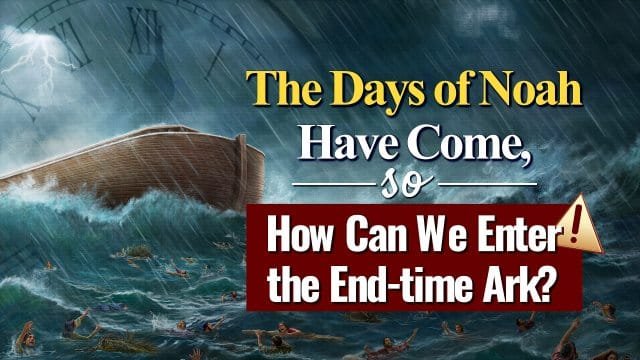
Jesus also compared the days preceding His coming with the days of Noah.
He said, “But as the days of Noe were, so shall also the coming of the Son of man be” (Matthew 24:37, KJV).
What makes this comparison so sobering is that people were living ordinary lives. Jesus said they were “eating and drinking, marrying and giving in marriage, until the day that Noe entered into the ark” (Matthew 24:38, KJV).
Then the flood came.
Jesus said, “And knew not until the flood came, and took them all away; so shall also the coming of the Son of man be” (Matthew 24:39, KJV).
The people of Noah’s generation were not living as though judgement was about to fall. Life continued. People made plans. They worked, ate, drank, married and carried on with ordinary activities.
That is part of the warning.
The return of Christ will not necessarily be preceded by the entire world suddenly becoming convinced that He is coming. People may be more interested in their everyday lives, their possessions, their careers, their entertainment and their plans for the future.
The danger is that people can become so absorbed in ordinary life that they forget eternity.
Watchfulness Without Date-Setting
This brings us to an important point. Bible prophecy should never be used as an excuse for date-setting.
Jesus said plainly:
“But of that day and hour knoweth no man, no, not the angels of heaven, but my Father only” (Matthew 24:36, KJV).
We therefore cannot responsibly announce the year, month or day of the rapture or the beginning of the Tribulation.
But there is a world of difference between date-setting and watching.
Jesus did not tell His followers to calculate the date. He told them to be ready.
“Watch therefore: for ye know not what hour your Lord doth come” (Matthew 24:42, KJV).
He repeated the warning: “Therefore be ye also ready: for in such an hour as ye think not the Son of man cometh” (Matthew 24:44, KJV).
We do not need to know the date to know that the time for spiritual preparation is now.
In fact, the uncertainty of the timing is precisely why we must remain ready.
The Rapture and the Hope of the Church
For believers in Christ, the return of the Lord is not merely a warning about judgement. It is also a promise of hope.
Paul described the catching away of believers in words that have brought comfort to Christians for nearly two thousand years:
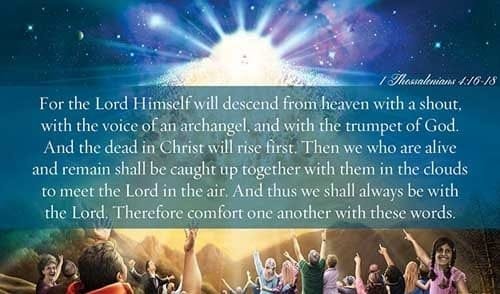
“For the Lord himself shall descend from heaven with a shout, with the voice of the archangel, and with the trump of God: and the dead in Christ shall rise first:”
“Then we which are alive and remain shall be caught up together with them in the clouds, to meet the Lord in the air: and so shall we ever be with the Lord.”
— 1 Thessalonians 4:16–17, KJV
Paul then concluded, “Wherefore comfort one another with these words” (1 Thessalonians 4:18, KJV).
Many Christians understand these verses to describe a pre-Tribulation rapture of the Church. Others understand the sequence of end-time events differently. There are sincere disagreements among Bible-believing Christians over the precise chronology of prophecy.
But those differences should not cause us to lose sight of what Scripture clearly teaches: Jesus Christ is coming again.
The believer’s responsibility is not to establish a date that God has chosen not to reveal. Our responsibility is to live in expectation of Christ and to tell others about Him while we have the opportunity.
Is the World Closer Than We Think?
Perhaps the most honest answer is that we do not know exactly how close we are.
It may be that the Lord’s coming is much nearer than many people imagine. It may be that events are developing that will eventually make the prophetic picture much clearer. It may be that the world is moving rapidly toward circumstances that will become obvious only in hindsight.
But we must resist the temptation to turn our observations into certainty that Scripture does not give us.
We cannot say, “The rapture will happen this year.”
We cannot say, “The Tribulation will begin on this date.”
We cannot claim that every international event is a direct fulfillment of a particular prophecy.
But neither should we make the opposite mistake and conclude that because we cannot know the date, there is no reason to pay attention.
Jesus said to watch.
Paul said to be sober.
The prophets warned about deception.
Scripture tells us that Christ is coming.
That is enough.
The Greatest Danger Is False Security
Perhaps this is the most important connection between Jeremiah, Ezekiel, and Paul.
The greatest danger may not be that people will hear a terrifying warning and deliberately reject it.
The greater danger may be that people will hear a reassuring message and never realise they are in danger at all.
Jeremiah’s generation heard, “Peace, peace; when there is no peace.”
Ezekiel’s generation heard, “Peace; and there was no peace.”
Paul describes a future generation hearing, “Peace and safety.”
In each case, the danger lies in believing that everything is secure when God’s Word says otherwise.
That should cause us to examine the messages being given to us today.
When politicians promise that they can ultimately secure the future, we should remember that governments are temporary.
When religious leaders promise a future without judgement, we should compare their words with Scripture.
When society tells us that mankind will eventually solve every problem, we should remember what the Bible says about sin.
And when the world tells us that there is plenty of time to think about God, we should remember the words of Scripture: “Behold, now is the accepted time; behold, now is the day of salvation” (2 Corinthians 6:2, KJV).
The Message We Must Never Lose
Bible prophecy is important, but prophecy should never become more important to us than the Person at the centre of it.
The purpose of prophecy is not merely to give us something fascinating to discuss. It is intended to turn our hearts toward God, strengthen our faith, encourage holy living and warn those who are not prepared.
The central message of the Bible is not that we should become experts at identifying prophetic events.
The central message is that Jesus Christ saves sinners.
The apostle Paul described the gospel in wonderfully simple terms:
“For I delivered unto you first of all that which I also received, how that Christ died for our sins according to the scriptures; And that he was buried, and that he rose again the third day according to the scriptures.”
— 1 Corinthians 15:3–4, KJV
This is the message that every person needs to hear.
We are sinners.
Christ died for our sins.
He was buried.
He rose again.
And salvation is available through Him.
The Bible says, “Believe on the Lord Jesus Christ, and thou shalt be saved” (Acts 16:31, KJV).
That is not a political promise.
It is not a prediction.
It is the promise of God.
There Is No Reason to Wait
If you have never trusted Jesus Christ as your Saviour, please do not wait for some future event to convince you that the Bible is serious.
You do not need to wait for another war.
You do not need to wait for a peace treaty.
You do not need to wait for the rapture.
You do not need to wait for the Tribulation.
You do not need to understand every prophecy in Daniel or Revelation.
The invitation of the gospel is available now.
Paul wrote, “Behold, now is the accepted time; behold, now is the day of salvation” (2 Corinthians 6:2, KJV).
None of us has been promised tomorrow.
That does not mean that we should live in panic. It means that we should live in reality.
The future is in God’s hands.
Christ is coming.
Judgement is coming.
But salvation is available today.
What Should We Do?

The answer is not to panic over every headline or attempt to identify the date of the rapture. The answer is to take God’s Word seriously.
If you are not saved, come to Jesus Christ.
If you are saved, remain faithful to Him.
Study the Scriptures so that you are not deceived.
Be cautious about those who promise peace while ignoring sin, judgement and the gospel.
Pray for your family and friends.
Tell people about Jesus Christ.
And keep watching for the return of the Lord.
Paul’s words immediately following his warning about “peace and safety” are particularly appropriate:
“Therefore let us not sleep, as do others; but let us watch and be sober” (1 Thessalonians 5:6, KJV).
That is the balance Scripture gives us. We are not to live in fear, but neither are we to live in spiritual sleep. We are not to set dates, but neither are we to ignore the signs and warnings Scripture has given us. We are not called to predict exactly when Christ will return; we are called to be ready when He does.
The world may continue searching for peace. Nations may continue negotiating. Leaders may continue promising security. Religious voices may continue assuring people that everything will eventually work out.
But there is a peace that only Jesus Christ can provide, and there is a security that only He can give.
The world may say “Peace and safety.”
The Bible warns us that there can be “peace” when there is no peace.
And somewhere beyond all the promises of politicians, all the assurances of religious leaders, all the plans of nations and all the ordinary routines of human life stands the promise of Jesus Christ:
He is coming again.
We do not know the day.
We do not know the hour.
We cannot set the date.
But we can be ready.
If you have never trusted Jesus Christ as your Saviour, do not allow another day to pass assuming that you have plenty of time. The Bible says, “now is the accepted time.”
And if you already belong to Christ, do not let the apparent normality of life put you to sleep.
Watch.
Be sober.
Stay faithful to the Word of God.
And tell others about the Saviour while there is still opportunity.
The final word belongs not to the politicians, the false prophets or the voices of this world, but to the Lord Jesus Christ:
“Even so, come, Lord Jesus.”
— Revelation 22:20, KJV